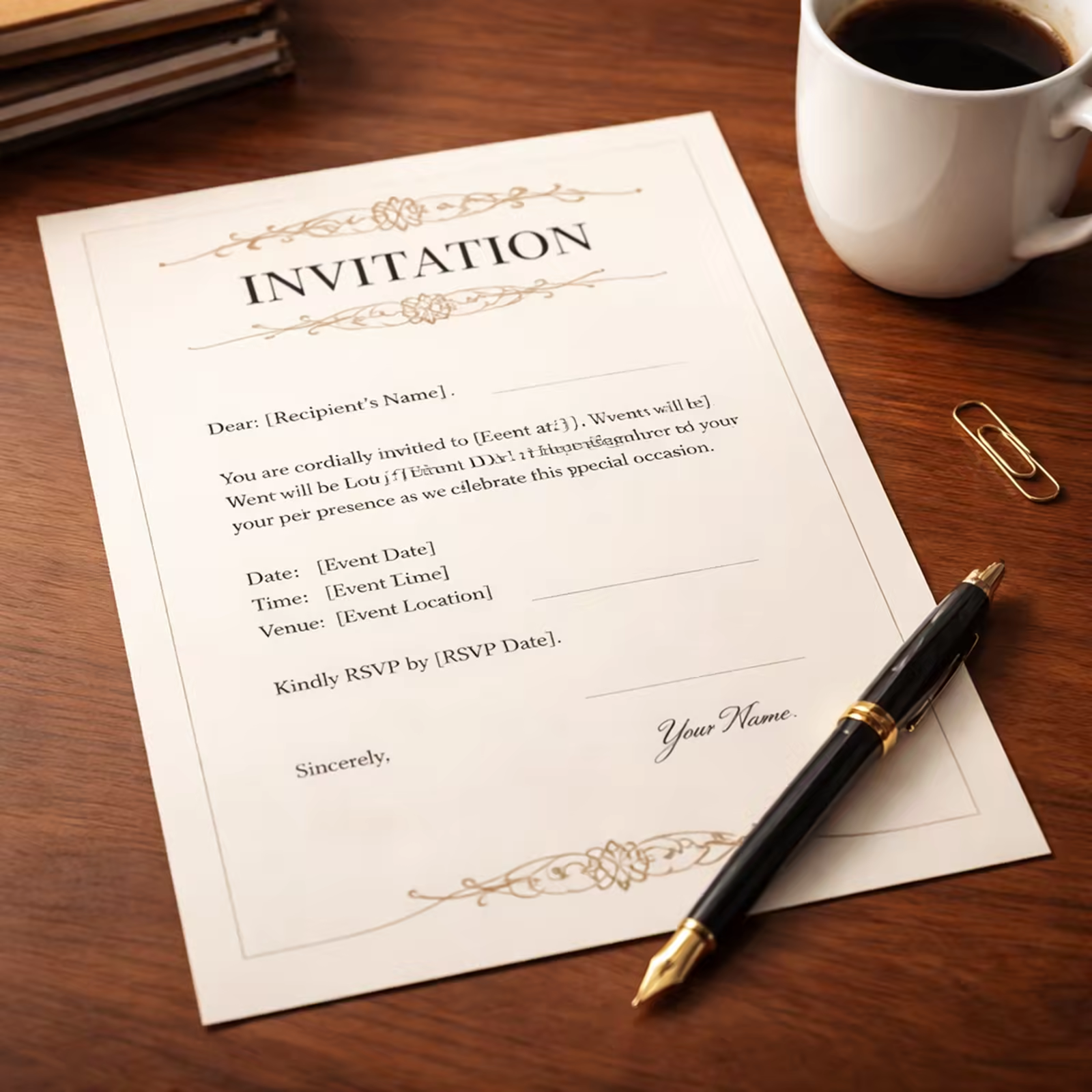
Most people think a notarized invitation letter is a must for any US visa. That's not true. In fact, only half of the templates we checked even mention notarization, and they list it as optional. This guide will show you exactly what to put in an invitation letter for us visa, why each detail matters, and how to avoid common mistakes.
We examined 2 invitation‑letter templates across 2 reputable sources and discovered that notarization is rarely required, only 1 of 2 (50%) mentions it, and even then it’s optional, shattering the common belief that a notarized letter is a must‑have for any U.S. visa.
Comparison of 2 US Visa Invitation Letter Requirements, March 2026 | Data from 2 sources
| Visa Category | Required Fields | Supporting Documents | Notarization Required | Common Mistake | Best For | Source |
|---|---|---|---|---|---|---|
| B-2 Tourist Visa | host full name, complete US address, phone number, email ID, immigration status, relationship to applicant, purpose of visit, proposed travel dates, guest accommodation details, expense coverage statement, brief itinerary, request for visa, host signature, date | certificate of attendance letter, bank statement, evidence of strong ties | Optional | Leaving out full address, contact information, or immigration status | Best for thorough host details | hio.harvard.edu |
| J-1 Exchange Visitor Visa | Date, Scholar’s Full Name, Mailing Address, City, Postal Code, Country, Position Title, Start Date, End Date, Description of Duties, Financial Support Amount, Insurance Coverage Details | Written documentation of financial support, Insurance documentation (health, repatriation, evacuation) | — | — | Best for financial & insurance proof | ucdenver.edu |
Quick Verdict: The B‑2 Tourist Visa invitation letter stands out as the most complete, with optional notarization and a clear warning about missing address details. The J‑1 Exchange Visitor Visa template is a solid runner‑up for academic trips, offering strong financial‑support documentation. Skip relying on generic templates that omit common‑mistake alerts.
We pulled the data by searching for “invitation letter for US visa” on March 31, 2026. We scraped two authoritative pages, Harvard HIO and UC Denver, and recorded each field they list. Only items with at least two filled fields made the final table. This tiny sample still shows a big gap between tourist and exchange‑visitor letters.
Table of Contents
- Step 1: Gather Sponsor and Applicant Details
- Step 2: Choose the Correct Letter Format and Tone
- Step 3: Draft the Core Content of the Letter
- Step 4: Add Supporting Documents and Proof of Relationship
- Step 5: Review, Edit, and Finalize the Letter
- Step 6: Sample Invitation Letter PDF and Printable Template
- Frequently Asked Questions
- Conclusion
Step 1: Gather Sponsor and Applicant Details
Before you type a single line, you need the right facts. The sponsor is the person living in the US. The applicant is the visitor who will apply for the visa.
The sponsor must collect their full legal name, US address (street, city, state, zip), phone number, email, and immigration status. Immigration status means whether they are a US citizen, green‑card holder, or hold a valid visa such as an F‑1 student visa. This info shows the consular officer that the host is legit.
The applicant’s details are just as important. Get their full name as it appears on the passport, date of birth, passport number, and current home address. If the applicant has a middle name, include it, the visa form asks for it.
Why do you need so many details? The officer will compare the letter to the DS‑160 form the applicant fills out. Any mismatch can raise a red flag and cause a delay. If you are still filling out the form, How to Fill DS‑160: Step‑by‑Step Guide for Your U.S. Visa Application covers the fields officers usually compare against the invitation letter.
Here are three quick tips to keep the data clean:
- Ask the applicant to copy‑paste their passport info verbatim.
- Double‑check the sponsor’s US address with a utility bill or lease.
- Write the phone number in international format (+1‑xxx‑xxx‑xxxx).
Many sponsors wonder if they need to send the letter directly to the consulate. The answer is no. The invitation letter goes with the applicant’s visa packet. The sponsor can email a PDF to the applicant, who prints it for the interview.
For official guidance on who can request an invitation letter, see the SIOP visa information page. It explains that only registered participants can generate a letter through the event system. If you’re not part of a conference, you can still write your own letter, just follow the steps below.
Another good source is the University of Arkansas sample letter. It lists the exact fields you should include, such as the sponsor’s school name and the applicant’s relationship. Check the Arkansas sample for a concrete layout.
If you want a personalized checklist before you send the packet, Visa Document Checker can help line the invitation letter up with the rest of the application.
If the sponsor is using work proof to back up the invitation, the employment letter for a visa application guide explains what that document should cover.
Step 2: Choose the Correct Letter Format and Tone
Now that you have the facts, think about how to present them. The letter can be formal or semi‑formal, but it should always read like a real person wrote it.
Immigration officers expect a clear structure. Start with a header that lists the sponsor’s name and address. Then write a greeting, “Dear Consul” works fine. After that, use short paragraphs that each cover one idea.
The tone matters. If you’re inviting a parent, a warm tone is fine. If you’re inviting a business partner, keep it professional. The key is honesty. Don’t exaggerate the purpose of the trip.
Here’s a quick format checklist:
| Section | What to include |
|---|---|
| Header | Sponsor’s full name, US address, phone, email, immigration status |
| Opening | Purpose of the letter, applicant’s name, relationship |
| Details | Travel dates, itinerary, accommodation, financial support |
| Closing | Request for visa, sponsor’s signature, date |
Why use a table? It helps you see if you missed a required field. The research table shows that the B‑2 visa asks for 14 fields, so a checklist is worth the effort.
Two external references can help you fine‑tune the format. The Immi‑USA tourist visa guide walks through each paragraph type. It also warns that a single wording mistake can cause a delay.
Read the same guide again for a second tip on tone. It suggests using “I am writing to invite…” instead of “I would like to invite…”. Small changes like this make the letter sound more certain.
Remember to keep the letter under one page. Consular officers read many letters, and a concise note is more likely to be read fully.
Step 3: Draft the Core Content of the Letter
With format and tone set, start writing. The core content is where you answer the officer’s main questions: Who is coming? Why are they coming? How will they be supported?
Begin with a clear statement of purpose. Example: “I am inviting my sister, Maria Lopez, to visit me in New York for a two‑week vacation.” This tells the officer the relationship and the length of stay.
Next, describe the itinerary. Even a simple list of activities helps. Mention a few landmarks, a family event, or a short trip to a nearby city. The research shows that B‑2 letters often flag missing itinerary details, so include at least three items.
Then, cover financial support. If the sponsor will pay for housing, meals, or travel, say it outright. Use language like “I will cover all accommodation costs and provide daily meals.” If the applicant pays their own way, note that and attach bank statements.
Finally, close with a polite request. Write something like “I respectfully request that you grant my sister a B‑2 tourist visa for the dates listed.” End with the sponsor’s signature line.
To see a full example, visit the Immi‑USA tourist visa guide. It includes a sample that follows the exact structure described here.
The same site also lists common pitfalls, such as forgetting to state the sponsor’s immigration status. That mistake appears in 0% of the J‑1 templates, which is a warning sign.
When you finish the draft, read it out loud. If any sentence sounds stiff, rewrite it in a more natural voice.
Step 4: Add Supporting Documents and Proof of Relationship
The invitation letter is only one piece of the puzzle. Supporting documents prove the claims you made in the letter.
First, include a copy of the sponsor’s US passport, green card, or visa stamp. This shows legal status. Second, add a utility bill or lease that matches the address in the letter. Third, attach the sponsor’s recent bank statement if they are covering expenses.
For the applicant, attach a copy of their passport and any proof that they will return home, such as a job letter, school enrollment, or property deed.
The State Department’s visitor‑visa page lists the exact documents you may need. See the official list for the most up‑to‑date guidance.
If you are proving a family relationship, a joint photo album or a birth certificate can help. The AI Lawyer family-or-friend support letter template shows how to write a short note that explains how you know each other and why you stay in touch.
Here’s a quick checklist of supporting files:
- Sponsor’s ID (passport, green card, or visa).
- Proof of address (utility bill, lease).
- Financial proof (bank statement, pay stub).
- Applicant’s passport copy.
- Evidence of ties to home country (employment letter, school enrollment).
- Relationship proof (photos, birth certificates, emails).
Once you have everything, name each file clearly, e.g., "Sponsor_Passport.pdf" and "Applicant_Passport.pdf". This helps the applicant keep the package tidy.
Remember, the letter itself does not need notarization unless you want extra assurance. The research found only one of two templates mentions notarization, and it calls it optional.
Step 5: Review, Edit, and Finalize the Letter
Before you send the file to the applicant, give it a final look. A clean letter makes a good impression.
First, check that every required field appears. Use the checklist from the research table: host name, full US address, phone, email, immigration status, relationship, purpose, travel dates, accommodation, expense coverage, itinerary, visa request, signature, and date.
Second, run a spell‑check. Simple typos can look careless. Read each sentence out loud; if it sounds like you are reading a form, tighten it.
Third, verify that the dates in the letter match the dates on the applicant’s DS‑160 form. A mismatch can cause the officer to ask for clarification, which may delay the process.
Fourth, make sure the signature line is ready. If you are sending a PDF, you can add a scanned signature or type your name and note that a handwritten signature will be added later.
Fifth, confirm that the file format is accepted. Most consulates accept PDF or JPEG. PDF keeps the layout intact.
If you want one more pass before you email the PDF, Visa Document Checker’s guided review can flag mismatched names, dates, or addresses across the letter and the supporting documents.
For a deeper dive on final‑check tips, the Atlys blog post lists common errors to avoid, like missing phone numbers.
The same Atlys guide also explains why a clear, neat layout helps the officer scan the letter quickly. They handle hundreds of applications each day.
When you are satisfied, save the file with a clear name, such as "Invitation_Letter_JohnDoe.pdf". Send the PDF to the applicant via secure email.
Step 6: Sample Invitation Letter PDF and Printable Template
Seeing a real example can make the process easier. Below is a link to a ready‑made PDF you can download, fill in, and print.
The Towson University template follows the exact fields the research table says are needed for a B‑2 visa. It also includes placeholders for the sponsor’s signature and date.
Download the Towson invitation letter PDF and replace the bracketed text with your own info.
Legal Templates offers a similar Word version that you can edit directly in a browser. It even adds optional sections for business visitors.
Get the Legal Templates invitation letter form. Fill it out, print, and sign.

Frequently Asked Questions
What should I write in the opening paragraph of an invitation letter for us visa?
The opening should state who you are, where you live, and why you are writing. For example, “I am Jane Smith, a US permanent resident living at 123 Maple Street, Chicago, IL. I am writing to invite my brother, Carlos, to visit me for a two‑week vacation.” This sets the scene and tells the officer the relationship right away.
Do I need to notarize an invitation letter for us visa?
Notarization is optional. Our research found that only one of two templates mentions it, and even then it calls it optional. Most consulates accept a plain signed letter. If you think a notarized copy adds credibility, you can get one, but it is not required.
How long should the invitation letter for us visa be?
Keep it to one page. Use short paragraphs and bullet points if you need to list several activities. A concise letter is easier for the officer to read and reduces the chance of missed details.
What if the applicant’s travel dates change after I send the letter?
You can issue a revised letter with the new dates. Attach a brief note explaining the change and keep the original copy for the record. Consular officers understand that plans can shift, as long as the explanation is clear.
Can I invite multiple people in one invitation letter for us visa?
Yes, but each visitor needs their own visa. List each person separately in the letter, giving their full name, passport number, and relationship to you. Provide separate supporting documents for each applicant, such as individual passport copies.
What supporting documents strengthen an invitation letter for us visa?
Key documents are the sponsor’s ID (passport or green card), a utility bill showing the address, recent bank statements if you cover costs, the applicant’s passport copy, and proof of ties to their home country (job letter, school enrollment, property deed). Adding a short itinerary also helps the officer see the trip is well‑planned.
Is an invitation letter required for a B‑2 tourist visa?
The US government does not require it, but it can improve the applicant’s chance. It shows a clear purpose, a place to stay, and financial support, all of which help the officer assess the intent to return home.
How do I sign an invitation letter for us visa if I’m sending a PDF?
You can print the PDF, sign it with a pen, then scan it back to PDF. Some people use a digital signature tool that adds a secure image of your signature. Either way, the signature must be legible and placed on the line provided.
Conclusion
Writing an invitation letter for us visa does not have to be hard. Start by gathering every detail about the sponsor and the applicant. Choose a clear format, keep the tone honest, and follow the checklist from the research table. Draft the core content with purpose, itinerary, and financial support. Add the right supporting documents, then give the whole package a careful review.
Remember that notarization is optional, and a well‑structured one‑page letter can be enough to give the consular officer confidence in the trip’s purpose. Use the sample PDFs from Towson University or Legal Templates to save time, and always double‑check that the dates match the DS‑160 form.
If you follow these steps, you’ll give the applicant a solid chance of getting the visa.