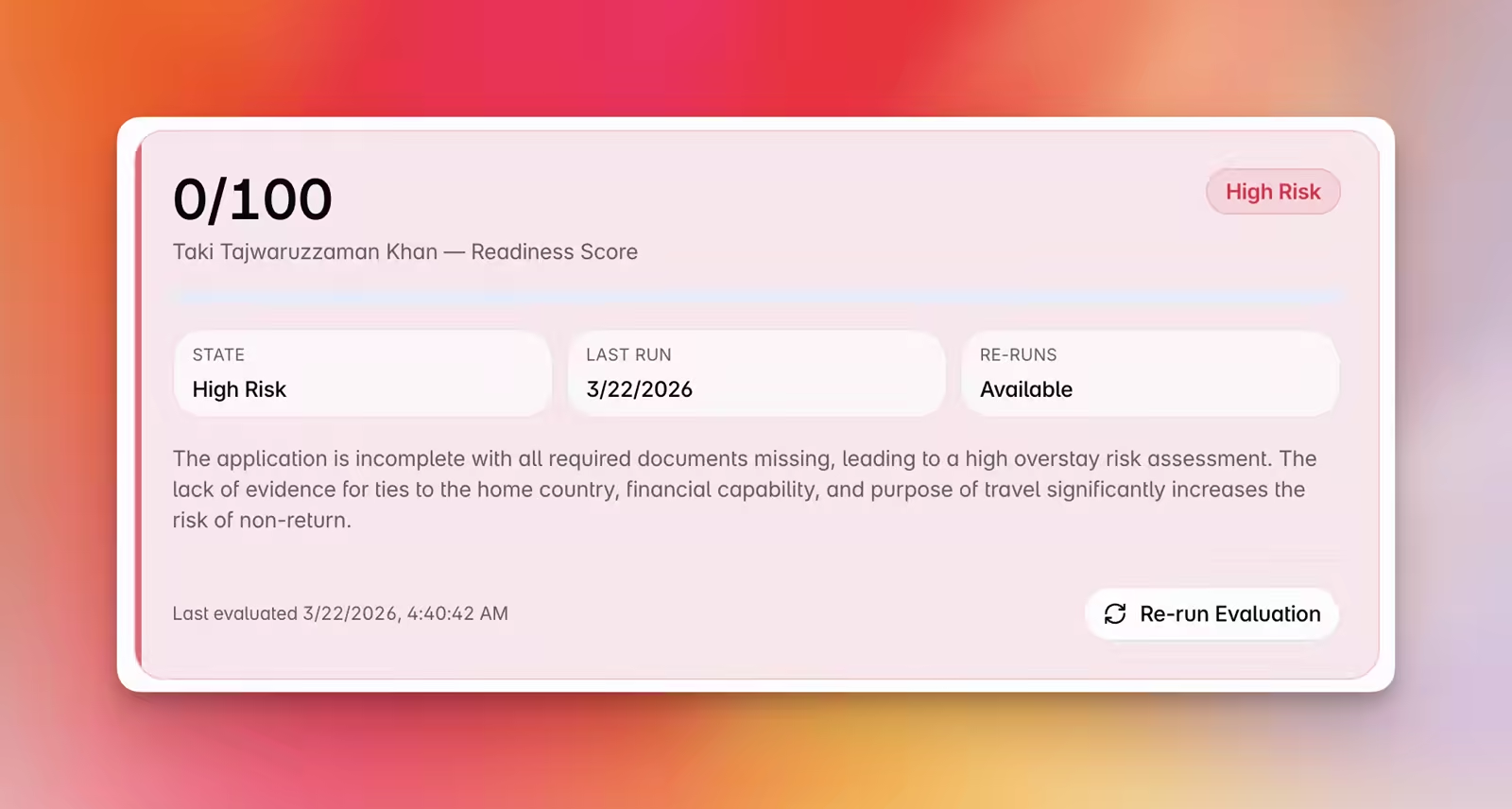

A lot of visa refusals are not about eligibility. They come down to paperwork: missing documents, mismatched details, outdated statements, or insurance that does not actually meet the rules.
To an applicant, those issues can feel minor. To a consular officer reviewing applications every day, they stand out fast.
The most common reasons visa applications get rejected
1. Insufficient financial evidence
One of the most common problems is weak financial documentation. That does not always mean your balance is too low. More often, it means the documents do not clearly show that you can pay for the trip without putting your normal life at risk.
Common issues include:
- Bank statements that do not cover the full required period. Many embassies ask for the last three months. If your statements stop well before your application date, that gap raises questions.
- Large deposits with no explanation. A sudden transfer right before applying can look like borrowed money added to strengthen the file.
- An account that regularly drops near zero. That can suggest you may not have enough funds available while traveling.
- Statements from the wrong account. Applicants sometimes submit business or joint account statements when the embassy wants personal banking records.
What officers want to see is fairly simple: stable income, a balance that makes sense over time, and enough money to cover both the trip and your regular expenses at home.
If you want a more focused breakdown of this part of the file, read proof of funds for a visa application.
2. Inconsistencies across documents
Consular officers do not read documents one by one. They compare them.
A small mismatch can be enough to trigger extra scrutiny or a refusal. It might be a date, a salary figure, a spelling difference in your employer's name, or an address that does not match.
Common cross-document problems:
| Inconsistency | Why it's flagged |
|---|---|
| Employer name in letter differs from bank statement header | Suggests an error or possible fabrication |
| Employment start date in letter contradicts payslip dates | Makes both documents less reliable |
| Travel dates in application do not match hotel bookings | Suggests incomplete planning or inaccurate information |
| Address in application differs from utility bill | Creates identity verification questions |
| Salary in letter does not match salary credited in bank account | Suggests one of the documents may be wrong |
This is exactly the kind of issue people miss when reviewing their own paperwork. Tools like Visa Document Checker are useful here because they compare documents against each other, not just in isolation.
3. Missing or incomplete employment documents
An employment letter can be present and still be too weak to help. Many embassies expect it to include a full set of details:
- Your full name, exactly as it appears on your passport
- Your job title
- Your employment start date
- Your monthly or annual salary
- Confirmation that your leave is approved for the travel dates
- Confirmation that you are expected to return to work after the trip
When one of those pieces is missing, the refusal often shows up under language like "insufficient evidence of employment ties."
If you are asking HR for a revised letter, use employment letter for a visa application as a practical checklist.
4. Travel insurance that does not meet the rules
For Schengen applications especially, travel insurance is a frequent problem. Applicants often submit a policy that looks fine at a glance but fails on one technical requirement.
Common issues include:
- Coverage below the required EUR 30,000 minimum
- No clear statement that coverage applies across Schengen member states
- Policy dates that do not cover the full stay
- Insurance from a provider the embassy does not accept
- Missing emergency medical evacuation or repatriation language where required
This is one of those areas where the document can look complete to you and still fail the embassy's actual checklist.
5. Weak proof of ties to your home country
Visa officers also look at whether you are likely to return home after the trip. That is why proof of local ties matters so much.
Useful evidence can include:
- Property ownership records or a lease in your home country
- An employment letter confirming you are expected back at work
- Family registration documents, especially if you have dependents
- Proof of an ongoing business or other financial commitments at home
- Enrollment in a course or program that requires your return
If your file includes very little tie evidence, especially for a first trip to a closely reviewed destination, the rest of the application has to work harder.
6. Photos that do not meet the specification
Photo rules are strict, and they vary by country. A photo that seems fine to you may still be rejected for size, framing, background, or recency.
| Country/Visa | Size | Background | Other requirements |
|---|---|---|---|
| Schengen | 35x45mm | White | Face 70 to 80 percent of frame height |
| US | 2x2 inches (51x51mm) | White | Taken within 6 months |
| UK | 45x35mm | Light grey or cream | No glasses |
| Canada | 50x70mm | White or light-colored | Face 31 to 36mm in height |
| Australia | 45x35mm | White | Neutral expression |
Photo booths and local print shops do not always get these details right. If the photo misses the spec, some applications are returned before they move any further.
7. Incomplete or incorrect application forms
Application forms create problems more often than people expect. The issue is usually not one big lie. It is small omissions or careless inconsistencies.
Common examples:
- Travel history left incomplete. On US applications in particular, missing trips from the past ten years can cause problems because officers compare your answers with passport records.
- Address mismatches. The address on the form should match your supporting documents exactly.
- Wrong visa category. Applying as a tourist when the real purpose of travel is business can be treated as misrepresentation.
- Blank fields left empty. If a question does not apply, many forms should be completed with "N/A" instead of being skipped.
How to avoid these mistakes before you submit
Most of these refusals follow the same pattern: the applicant looks at each document separately, while the officer looks at the package as a whole.
For a shorter, route-by-route version of that final review, see how to avoid visa rejection due to document mistakes.
Before you submit, check that:
- Every document covers the right dates, with no gaps.
- Your name, address, and employer details match across the full set.
- Your bank statements show a believable financial story, not just a final balance.
- Your employment letter includes salary, leave approval, and return-to-work confirmation.
- Your insurance meets the exact embassy requirements for your destination.
- Your photos match the size and composition rules for that country.
Visa Document Checker is built for this final review step. It cross-checks the documents you upload, flags inconsistencies, and compares them with embassy-specific requirements before a consular officer sees the file.
This article covers common document-related refusal patterns across Schengen, US, UK, Canada, and Australia visa applications. Requirements change, so check the official embassy website before you submit.